
What a truck roll actually costs a solar installer, and how to work out yours
There is no industry average truck roll cost that applies to your business. There is only your number, built from your own labour rate, drive time and overhead. Here is how to build it, and what the manufacturers pay back against it.
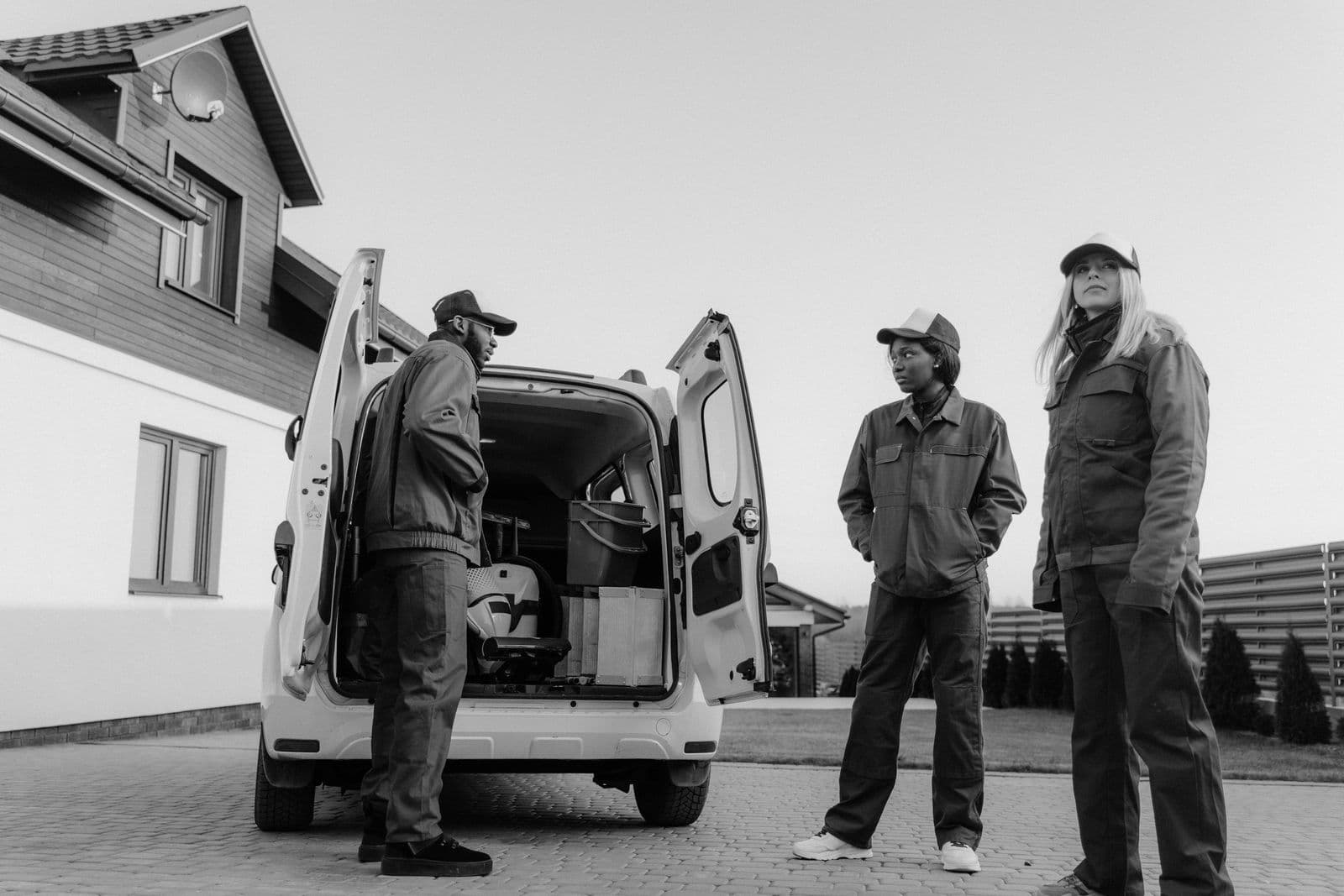
Photo: Pexels
A truck roll costs you a tech's paid hours door to door, the vehicle, the office time to book and chase it, and the install revenue you did not earn that day. No published average tells you yours. Build it from five of your own numbers, then set it against what each brand reimburses, which for most brands is nothing. The truck roll calculator does the arithmetic.
Why an industry average is worth nothing to you
A three-truck company doing dense suburban work in a metro area and a three-truck company covering two hundred miles of rural county have almost nothing in common on this number. Drive time swamps everything else. So do your wage rates, your vehicle costs, and whether the visit is the tech's first job of the day or a squeeze between two installs.
Anyone quoting you a single dollar figure for a solar truck roll is quoting you their region, their wage bill and their year. Use it and you will make the wrong call on every warranty decision that follows, because those decisions are all comparisons: repair or replace, chase the claim or eat it, buy the labour extension or not.
The number you need is yours, and it is not hard to build. It is five inputs and an afternoon.
The five inputs
| Input | Where it comes from | The trap |
|---|---|---|
| Loaded labour hours, door to door | Tech's hourly cost including on-costs, times the hours from leaving the yard to getting back | People count time on site and forget the drive both ways |
| Vehicle running cost | Fuel, insurance, maintenance and depreciation, expressed per hour or per mile | Usually already in your accounts as a fleet number, just not divided down |
| Office and scheduling time | Booking, calling the homeowner, calling the distributor, chasing the RMA, closing the job | The single most under-counted line, and on warranty work it is often the biggest one after labour |
| Parts and consumables | What leaves the van and does not come back | Only counts once, so decide whether it sits here or in the claim |
| The install that did not happen | Gross margin on the job the crew could have run instead | Ignore this and a warranty visit looks free on a slow week and cheap on a busy one |
That last line is the one installers argue about, and it is the one that decides whether the number is honest. If your crews are booked out, every warranty visit displaces revenue. If they are not, it does not. Work out both versions and use the one that matches your current book.

Do it per visit type, not per claim
Most warranty faults are not one visit. They are a diagnostic visit, then a replacement visit once the part arrives, and sometimes a return visit because the wrong part arrived or the fault was intermittent and did not present.
So build three numbers:
- Diagnostic visit. Shorter on site, same drive, same office time. Often the cheapest and the most likely to be wasted.
- Replacement visit. Longer on site, two people on anything on the roof, plus the old unit going back to the distributor.
- Return visit. The one that should not have happened. Cost it anyway, because it happens.
A claim on a rooftop microinverter is rarely one truck roll. Price it as the sequence it actually is.
What comes back from the manufacturer
This is where the number stops being an accounting exercise and starts being money. Labour cover is the exception in residential solar, not the rule. Across the brands in our warranty catalogue, most product lines carry a long parts term and no labour cover at all.
The exceptions, with the terms as the catalogue holds them:
| Brand and line | Labour cover |
|---|---|
| REC Alpha Pure-R | 240 months |
| Fronius Primo GEN24 Plus | 12 months |
| GoodWe ET Series | 12 months |
| Sungrow SH RT Hybrid | 12 months |
| Enphase, United States | $200 per truck roll plus $25 per replaced microinverter |
| Most other lines in the catalogue | None |
Enphase is the only brand here that pays a stated rate per visit rather than a term in months, which makes it the only one you can hold directly against your own figure. In the United States it reimburses $200 per truck roll plus $25 per replaced microinverter, and a paid Labor Protection Program extension stretches labour cover to five or ten years from activation. Whether $200 covers your visit is exactly the arithmetic this exercise exists to settle, and it is the arithmetic behind the Labor Protection Program decision.
Everywhere else the twelve month lines are worth reading precisely. Twelve months of labour cover on an inverter with ten years of parts cover means that from year two onward the manufacturer sends you a box and you send a truck, at your cost, for the remaining nine years.
The visits you should not have made
Once you have a per-visit number, the interesting question changes. It stops being "what does a truck roll cost" and becomes "how many of these did we not have to make".
Two categories are worth separating in your own records.
Visits caused by a fault. These are the cost of doing business. Parts fail.
Visits caused by paperwork. A claim that came back unrecognised because the serial was transposed. A second diagnostic trip because nobody photographed the nameplate the first time. A claim that turned out to sit outside a term that started earlier than anyone thought. These are avoidable and they cost exactly the same per visit as the real ones.
The second category also includes the conditions that silently shorten a term. GoodWe's ten year inverter term holds only while the unit is connected to the SEMS portal and uploading generation data, and is five years otherwise. Tesla's Powerwall term needs the unit to stay online, and if the connection drops and is not restored within 45 days of Tesla's written request, cover ends at 48 months. Neither of those produces a warning. Both of them turn a covered part into an uncovered one, and an uncovered part turns a reimbursable visit into a visit you fund and a conversation with the homeowner you would rather not have. There is more on this in why conditions matter more than deadlines.
Put the number where decisions get made
A truck roll cost that lives in a spreadsheet on one person's laptop changes nothing. It has to be in front of whoever decides whether a claim is worth chasing.
Three practical uses once you have it:
- Claim triage. If a claim's reimbursable value is below your visit cost and the brand pays no labour, you are making a commercial decision, not a warranty one. Make it deliberately.
- Brand selection. When two inverters are within a few dollars at the distributor, the one with twelve months of labour cover and the one with none are not the same product. Neither are the one whose term is conditional and the one whose term is not.
- Extension pricing. Any paid labour extension is worth buying when the expected number of covered visits times your visit cost exceeds the price. You cannot run that comparison without your own visit cost.
Do this week
Pull the last ten warranty visits. For each one write down the drive time, the on-site time, the office time and whether a second visit followed. Divide it out. That is your number, and it will be more accurate than anything published.
Then check what each of those ten brands actually owed you on labour. Use the warranty deadline calculator to confirm the terms were live on the day of the visit, and the claim checklist to see what the claim should have carried.
One note on where the product stands: Claim Timer holds the record for each piece of equipment and builds the claim pack when a part fails. It does not file with the manufacturer for you, and cost reporting across a quarter is not built yet. The per-visit arithmetic above is still yours to run. What Claim Timer removes is the second category of visit, the one caused by a record nobody kept.
Checked against
Warranty terms change and differ by country. Treat this as a starting point and check the manufacturer's current document before you rely on it.
Keep reading
Solar panel maintenance: what actually needs doing
Most solar maintenance advice is about cleaning glass. The maintenance that actually costs you money when it is skipped is the upkeep your warranty depends on, and it happens on a router and in a filing cabinet, not on the roof.
CostsIs the Enphase Labor Protection Program worth buying?
Enphase reimburses $200 per truck roll plus $25 per replaced microinverter in the United States, and the paid Labor Protection Program extends labour cover to five or ten years from activation. Whether that pays is arithmetic you run with your own visit cost.
Keep the serial, the photo and the date on every install
Claim Timer stores one record per piece of equipment, with the nameplate photo and the registration confirmation on it, so the claim has its proof already.